Our Process
Design thinking:
the missing link.
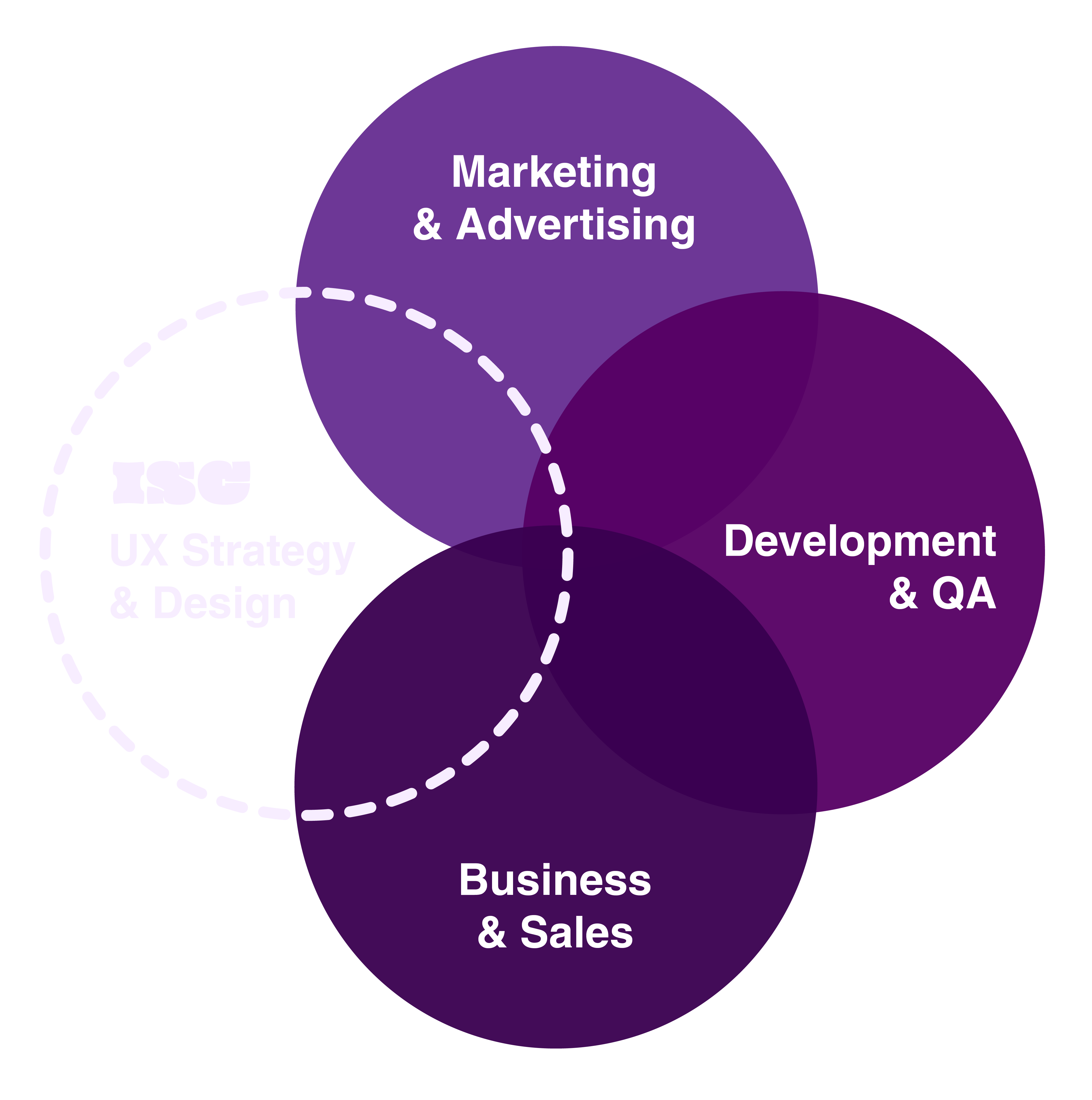
How we work alongside your team
We bring user-first design thinking to every stage of a digital project. Phases typically include:

Kickoff, user research, and discovery: Helps agencies and product teams validate what they are building before investing in design and development.
UX strategy development: Aligns business goals, user needs, and messaging so every page and flow has a clear purpose.
UX design & copywriting: Defines information architecture, user journeys, and interface patterns that designers and developers can follow, keeping teams aligned and reducing rework.
Development, QA, & UAT: Turns designs and content into a working product, with testing to catch issues early and ensure everything works as intended before launch.
Go-Live: Delivers a polished, ready-to-use experience that meets business goals, supports users, and is ready to scale.
Avoid turning small UX gaps into big delivery problems
On digital projects, seemingly small design decisions can have a big impact on costs later. When UX strategy is part of the process, agencies and product teams get better quality and more predictable delivery, which helps keep projects on time and on budget.
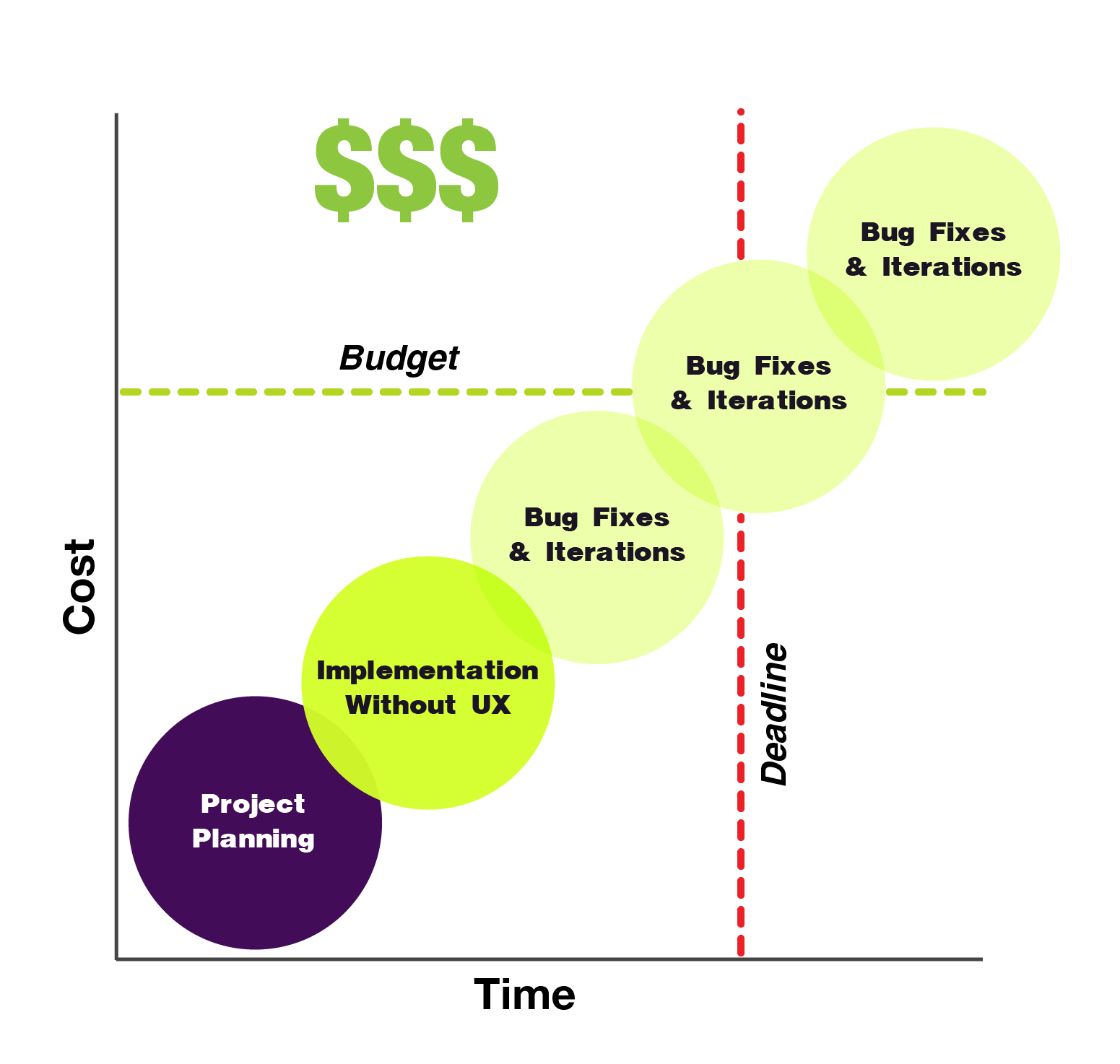
In the charts below, see how baking in UX strategy helps avoid budget snowballs.
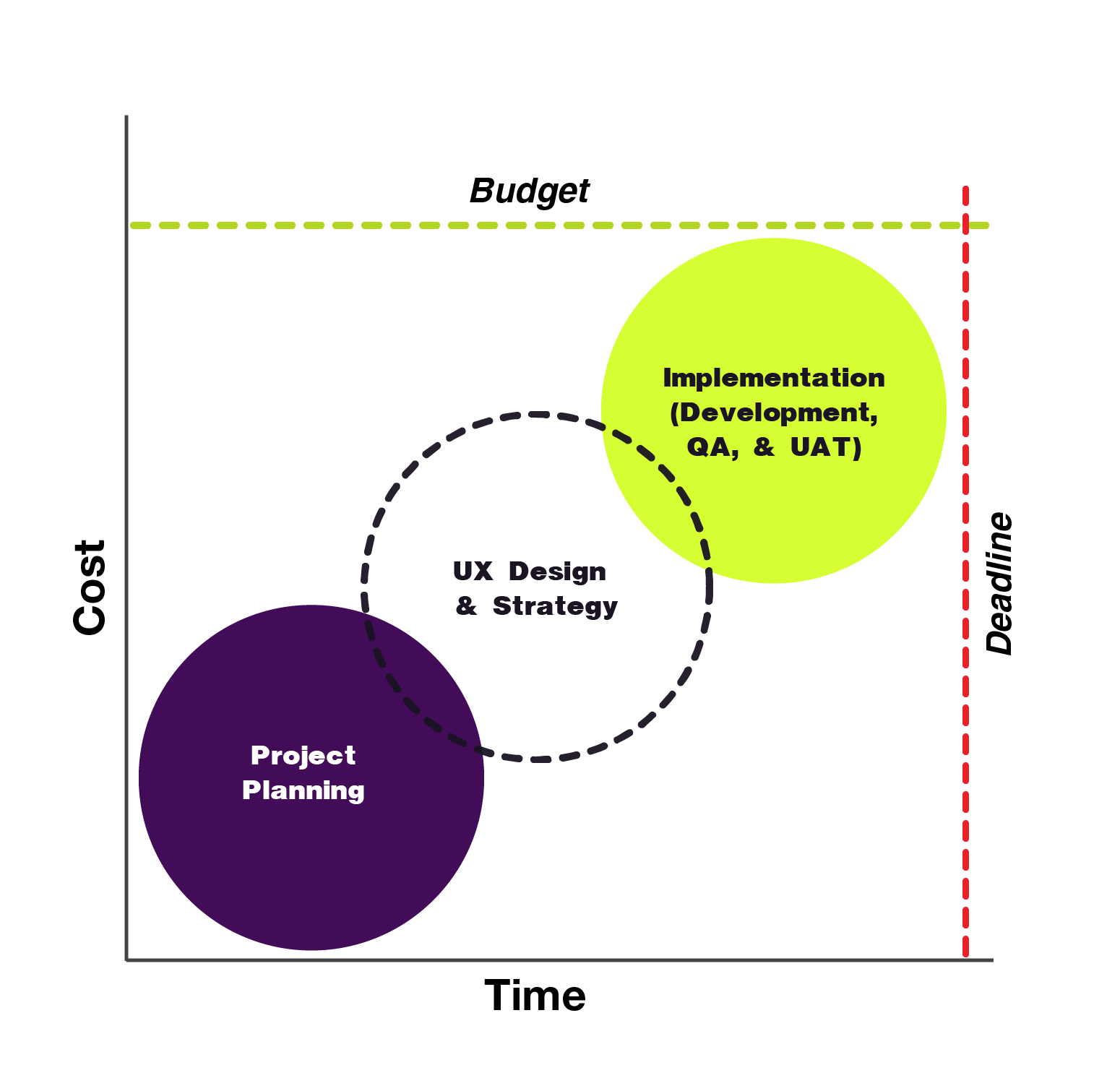
Implementation costs under control
In projects where UX strategy is baked in, time, cost, and quality stay predictable.
When creative and product teams take time to align on UX strategy and design, development moves faster and with fewer surprises. Clear requirements, responsive layouts, and shared expectations keep work inside the agreed timeline and budget while delivering top-tier quality.
Implementation costs not under control
In projects where UX strategy is not baked in, expect more bug fixes and iterations that push past the timeline and the budget, jeopardizing client trust and stakeholder confidence.
Jumping straight into development to save time and money is tempting. But skipping the critical phases of UX strategy and responsive design often leads to rework that drives up costs and puts both quality and client trust at risk.
Our Process
We follow a collaborative, step-by-step process to ensure every UX project meets the needs of your business and your users. From research to launch, we prioritize clarity, communication, and results.
- Step 1: Research & Discovery
- Step 2: Strategy & Planning
- Step 3: Wireframing & Prototyping
- Step 4: Visual Design
- Step 5: Testing & Refinement
- Step 6: Handoff & Support
Step 1: Research & Discovery
Every project begins with understanding your goals and your audience. Through stakeholder interviews, competitor analysis, and user research, we gather the insights needed to design experiences that connect. Google Analytics, industry reports and benchmarking, user testing, and heatmapping are some of the tools we use.
Step 2: Strategy & Planning
We translate research findings into a clear design strategy. This includes defining user personas, mapping user journeys, and outlining the information architecture to guide users seamlessly through your site or app.
Step 3: Wireframing & Prototyping
Our team creates wireframes and prototypes to outline the structure, flow, and key interactions of your product. Interactive prototypes allow you to visualize how the final design will function and provide valuable feedback before development begins.
Step 4: Visual Design
With the blueprint in place, we bring your brand to life through beautiful and functional design. Our user interfaces (UI) combine aesthetics with usability, ensuring consistency and accessibility across devices.
Step 5: Testing & Refinement
Before launch, we test designs with real users to validate assumptions and identify areas for improvement. This iterative process ensures that your product performs as expected and exceeds user expectations.
Step 6: Handoff & Support
We provide detailed design assets and guidance to your development team to ensure a smooth handoff. Post-launch, we remain a partner in your success, offering ongoing support and optimization to keep your digital experience performing at its best.
Why Our Process Works
Our structured yet flexible approach keeps projects on track, stakeholders aligned, and users at the center of every decision. By combining strategy, creativity, and rigorous testing, we deliver digital products that make a measurable impact.

Why Choose ISC?
With our combined decades of experience in UX design, website content writing, and UX content strategy, we can help you establish, fortify, and future-proof your website, app, intranet, or other digital product, giving you the tools you need to succeed to support your online goals.
Learn more about ISCOur Work
View samples of our work and read case studies showing how we increased organic traffic, engagement, and conversions for our clients.
View our work
Ready to turn UX into real business value?

Welcome more guests and increase engagement
Improve visibility in search and AI results
Deliver experiences that feel intuitive and on-brand
Align creative, product, and technical teams around shared goals
FAQs
Most projects follow our six-step process: Research & Discovery, Strategy & Planning, Creative, Testing & Refinement, and Handoff & Support. We start by understanding your users, your goals, and your competitive landscape, then build a solution that's validated before it launches.
Yes, we're built to slot in. Whether you have a well-established workflow or a loosely defined one, we adapt to fit your team's rhythm. That said, we won't abandon the fundamentals that make our work effective. Think of it as bringing your process and ours into a collaborative partnership.
We follow a process because not doing so costs more in the end. A structured process reduces rework, catches problems before they become expensive, and keeps everyone aligned on what's being built and why. It also means we're drawing on 40+ years of combined experience, not reinventing the wheel every time. Good process is how we've made the quality we deliver repeatable.
Working with a process like ours requires a small investment of time upfront, allowing for research, alignment, and strategy to take place. Doing so prevents costly delays that tend to happen when you skip those steps. In other words, 'moving fast' at the start and skipping process steps often ends up costing more time at the end.